
From the tea gardens of Sreemangal to the hills of Chattogram and the shore at Cox’s Bazar, the places to stay that stay with you are the ones that seem to grow from their ground. Notes from our hospitality work on letting the setting lead.
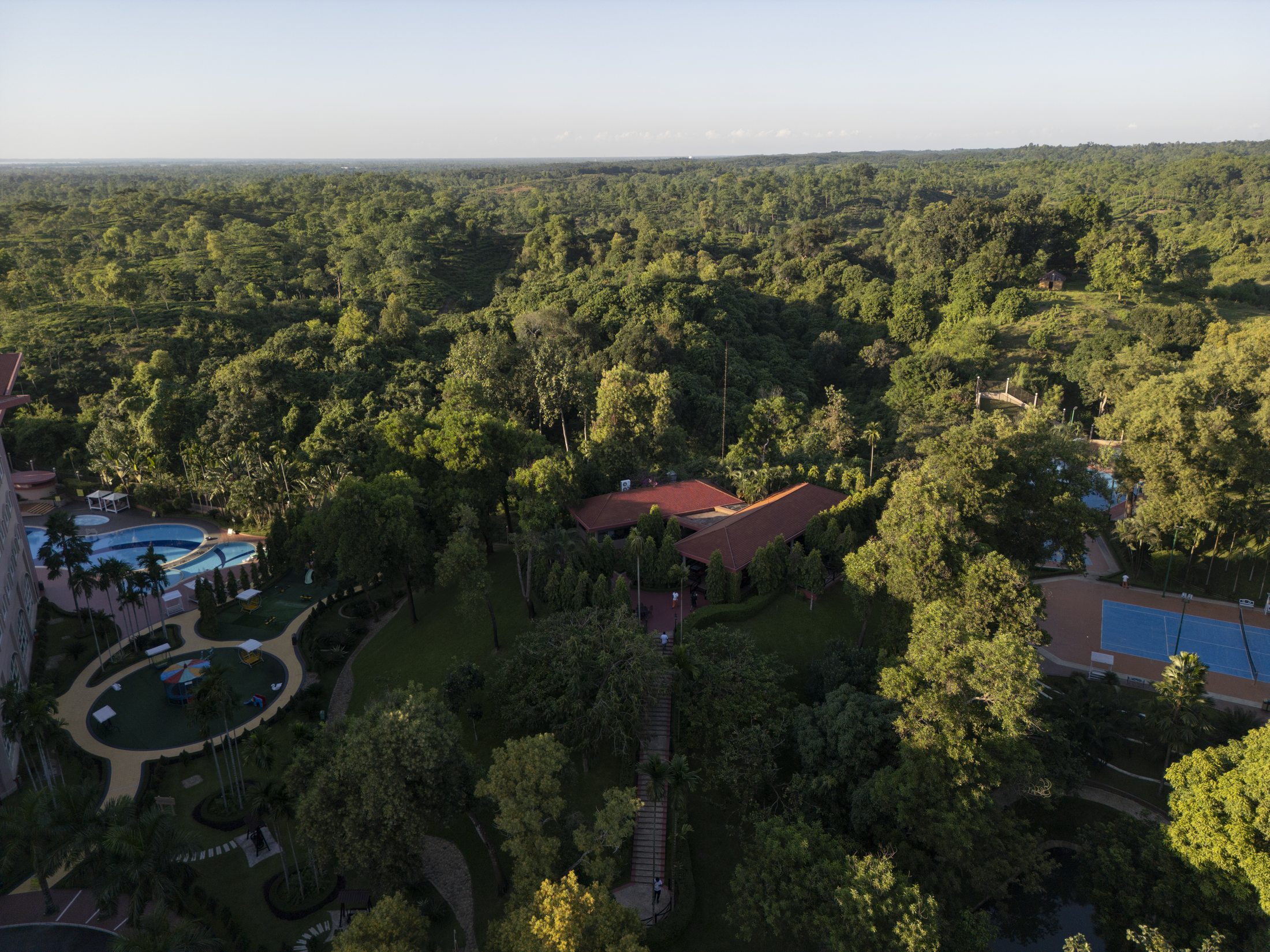
Grand Sultan Tea Resort & Golf, Sreemangal — the resort held inside the canopy of the tea gardens.

A hotel can be built almost anywhere. A place that feels as though it belongs where it stands is much rarer. In Bangladesh, where a resort might sit among tea gardens, on a coastal road or beside a great river, the landscape is usually the reason guests come at all — so it should be the first thing a design responds to, not the last thing it decorates.
Across our hospitality work, from a five-star resort in Sreemangal to a hillside retreat in Chattogram and beachfront schemes in Cox’s Bazar, four ideas keep returning. None of them is a style. Each is a way of letting the site make the decisions.
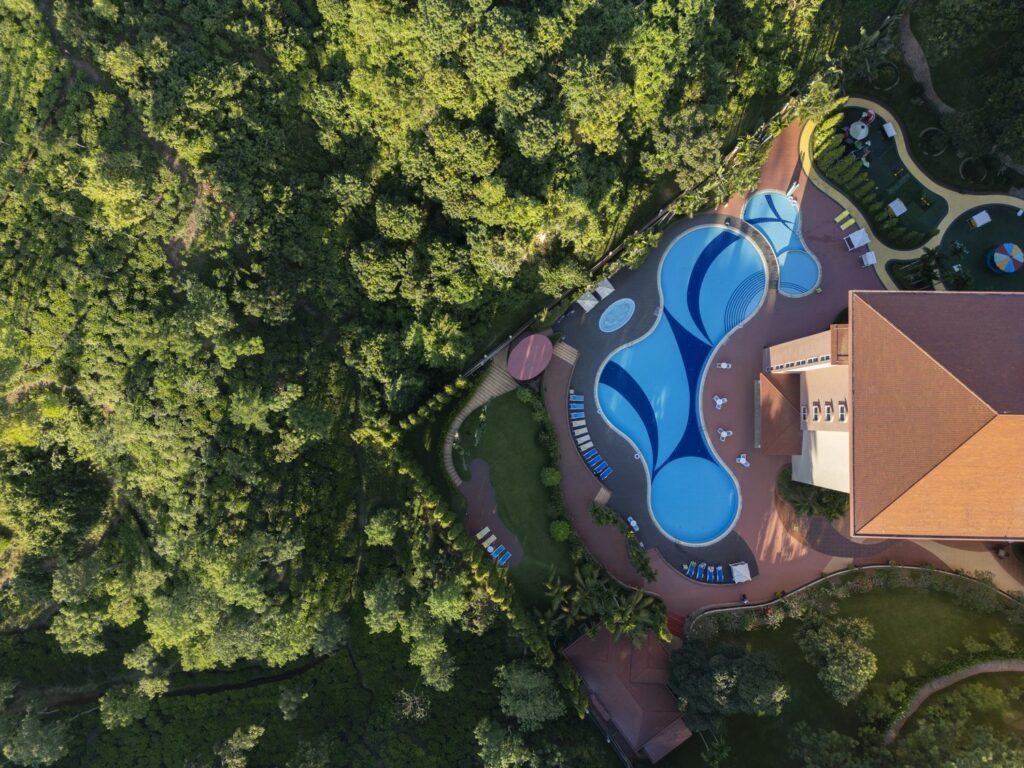
Sreemangal, the tea capital of Bangladesh, is layered with tea and citrus gardens, and it was that setting that gave rise to Grand Sultan Tea Resort & Golf. The site was once a lemon garden. What began as an unobtrusive four-storey idea had to become an eight-storey building for the resort to be viable — so the work of keeping it rooted fell to the ground around it. Landscaping, a mini golf course and a small lake tie the building back into its setting; the heated pool is tucked between three hills; the service building sits behind the main block, out of the guest’s view.
Its every curve, elevation and water body tuned to the surrounding nature.
From our project notes · Grand Sultan Tea Resort & Golf
At the top, the Hilltop Kabana — an open, live-kitchen restaurant — cantilevers out over the tea garden, so diners seem to float above the landscape that drew them there. The lesson is simple: when a programme grows, the landscape has to work harder, not disappear.
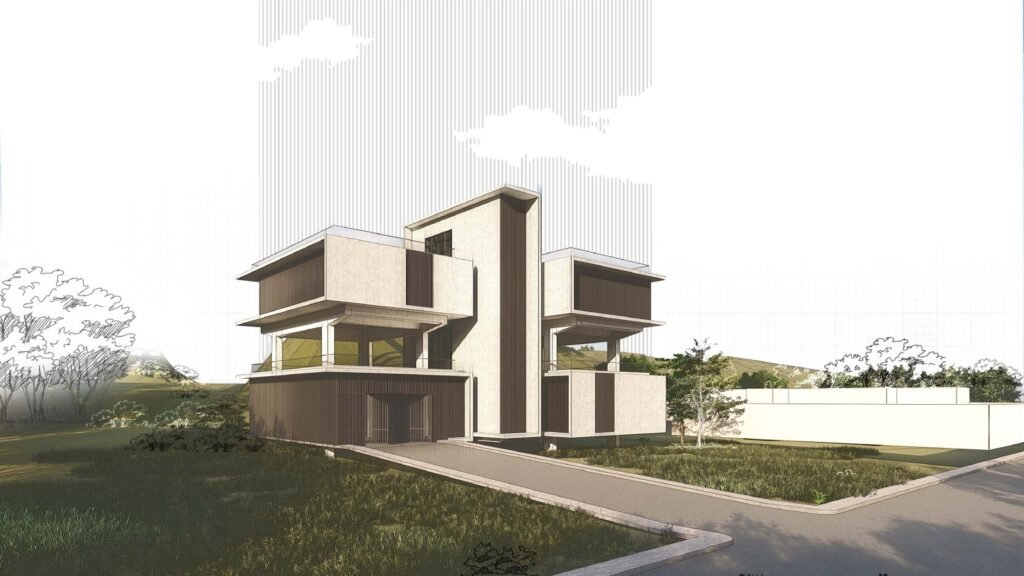
On sloping or sensitive sites, lifting a building can do more for the landscape than any amount of planting. Our proposal for Bird’s Nest, an elevated hillside bungalow in Barabkunda, Chattogram, raises the house off its contoured site to ease access, limit disruption to the ground and capture the outlook. Two lifted volumes are split by a circulation core and wrapped in louvres that give privacy from the nearby ship-breaking yard while keeping the house naturally ventilated. A bridge reaches from the roof to the eastern hill, so the building and the terrain stay in conversation.
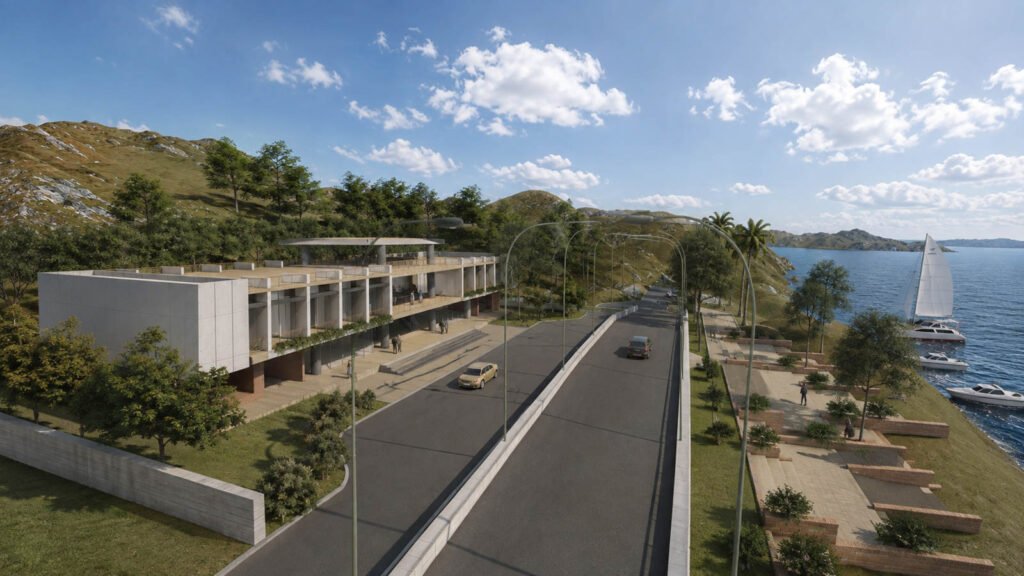
The same move works on the coast. At Marine Drive in Cox’s Bazar, the site is a narrow strip between hillside and sea wall, with the road running through it — exactly where a building risks closing the water off from everyone passing. The design runs long and low on the inland side and leaves its ground floor open as a raised timber deck, so sightlines carry straight through to the sea. Across the road, brick-edged planting terraces step down to the water.
In a delta country, water is never just a view. Our proposal for Recreation Zone – Asian Highway, a 19.5-acre retreat at Pakunda in Narayanganj, is anchored by a lake that drives natural drainage, tempers the micro-climate and, with tropical fruit and vegetable planting, supports a healthy food chain on site. Corridors of water and green link the reception, hall, restaurant and guest pavilions, and the structures lift partly off the ground to keep the visual connection with nature. Boating, fishing, tree trails and meditation spaces make the landscape itself the main amenity.
At larger scale the principle is about what you leave open. For Mawa Convention Center, the convention hall and hotel tower sit at opposite ends of a low glazed link, keeping a broad lawn open to the river between them, while the amusement park, jetty, villas and pool are pushed to the edges. The river frontage — the reason the site matters — stays shared.
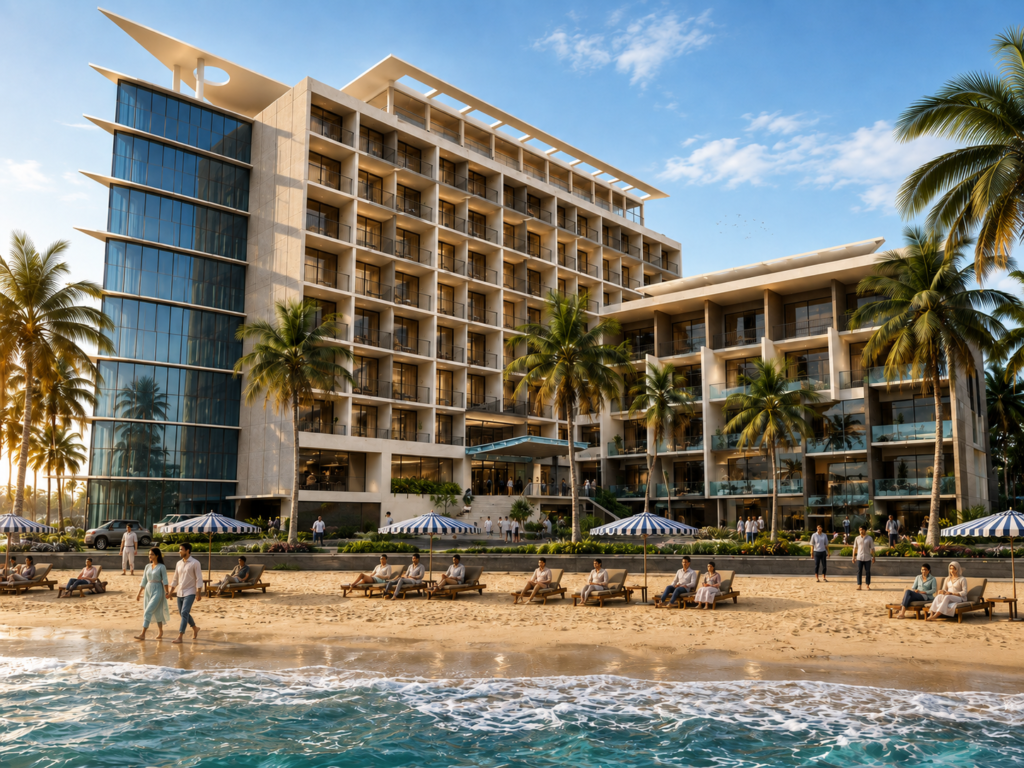
On an exposed beach, a hotel has to give as many rooms as possible a view of the water while keeping sun, salt air and glare off the rooms behind. At The Cox Bay, two blocks sit either side of a garden court. Both are built as a deep concrete grid, each room set back inside its own balcony so the frame shades the glazing, with horizontal louvres closing the openings behind. The planted court steps down from the arrival forecourt, through lawn and pool terrace, to the sand — the landscape doing the work of welcome as well as the work of climate.
For owners and operators, the practical takeaway is that landscape is not a finishing budget line. Walk the site before the brief is fixed. Protect the best ground, the best trees and the best view for guests rather than for service. Let the section answer the slope instead of levelling it. Treat water as infrastructure for drainage and cooling, not only as a feature. And shade before you glaze. Hospitality that belongs to its landscape keeps paying back in how guests feel the moment they arrive.
If you are planning a resort, hotel or retreat, we would be glad to walk the site with you. Start a conversation.
Written by the REINCARNATION studio, drawing on our project records. Each project’s status is listed alongside.
Projects in this journal
Sreemangal · Completed
Barabkunda, Chattogram · Proposed 2023
Cox’s Bazar · Design completed
Pakunda, Narayanganj · Proposed 2025
Mawa · Design completed
Cox’s Bazar · Design completed